
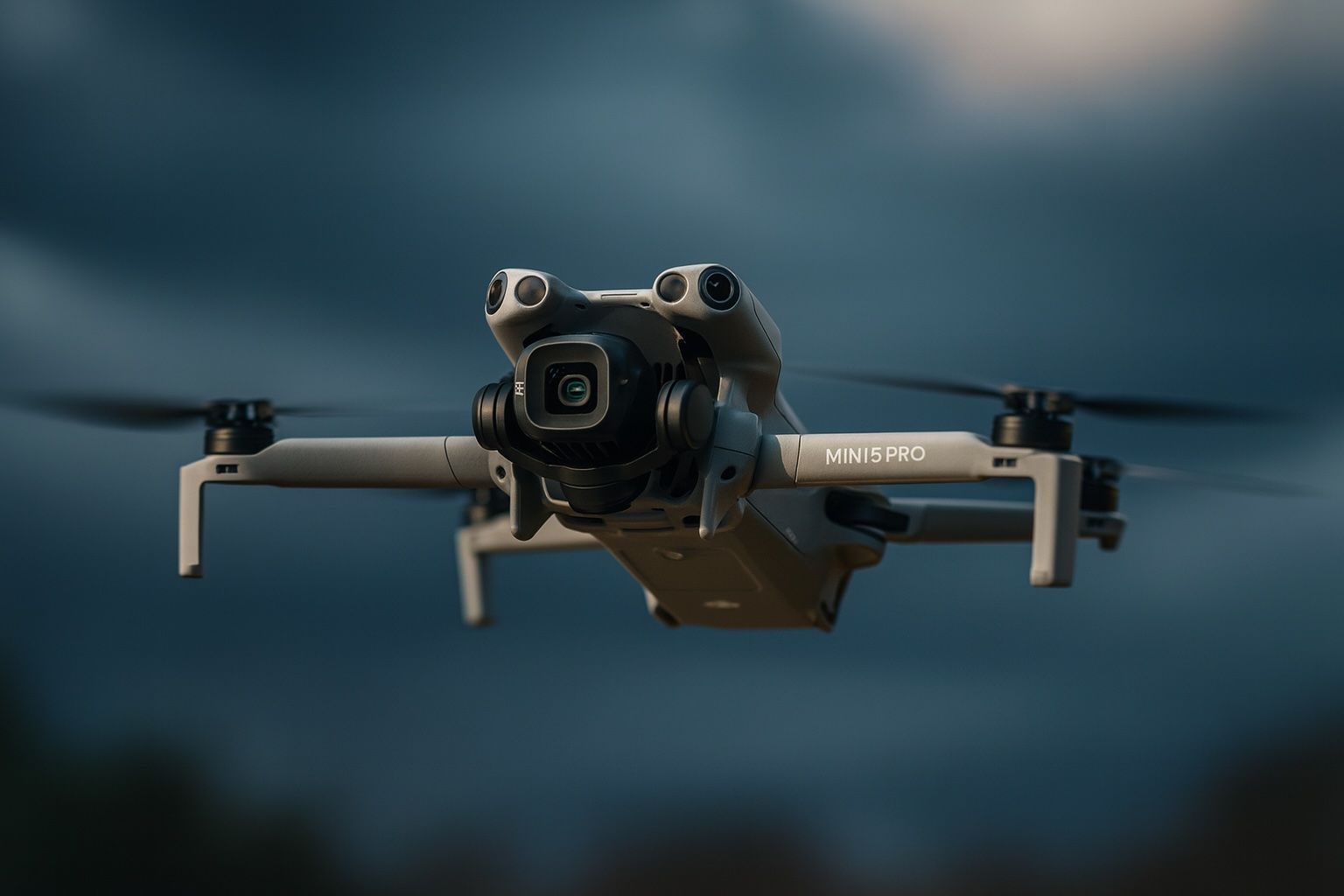
DJI Mini 5 Pro vs the Competition: Is This 249g, 1-Inch Sensor Drone a Game-Changer?
- First 249g drone with a 1″ sensor: The new DJI Mini 5 Pro packs a 50 MP, 1-inch CMOS camera (f/1.8) – unprecedented in an ultra-light drone. It shoots up to 4K/120fps video with 10-bit color and D-Log M, a huge leap from the Mini 4 Pro’s 1/1.3″ 48 MP sensor (max 4K/60fps) [1] [2]. Image quality and low-light performance now rival larger prosumer drones, beating many high-end compact cameras that can’t even fly [3] [4].
- Big boost in flight time: Thanks to a new high-capacity battery, the Mini 5 Pro can fly up to ~36 minutes on a standard pack, and an optional “Intelligent Flight Battery Plus” pushes endurance to ~52 minutes – shattering the Mini 4 Pro’s ~34 minutes standard (45 min with its Plus battery) [5]. This dramatic jump in airtime means less worry about swapping batteries mid-mission and more time capturing epic shots in one go [6].
- LiDAR obstacle sensing & safer flying: DJI added a front-facing LiDAR sensor to augment the Mini 5’s omnidirectional vision system [7]. This lets it “see” obstacles in the dark (glass, low-light, etc.), enabling 360° obstacle avoidance even at night and a smarter Return-to-Home that works down to near-dark 1 lux lighting [8] [9]. It’s a first for sub-250g drones – ActiveTrack 360° is improved too, letting the Mini 5 Pro track fast subjects (up to 15 m/s) with confidence [10].
- Under 250 g – no registration needed: Despite the upgrades, DJI kept the Mini 5 Pro’s weight at ~249 g (C0 class) [11]. This means in many countries it stays in the most permissive category (no registration or license needed for hobby use), a huge convenience for travelers and beginners. Its foldable design remains ultra-compact like the Mini 4 Pro, with minor tweaks like vented motors and downward LED landing lights for better cooling and night ops [12]. In short, it’s pro-level tech without the paperwork.
- O4 transmission & new controllers: Like the Mini 4 Pro, the Mini 5 uses DJI’s latest OcuSync 4 (O4) link with a 1080p/60fps live view and up to ~20 km range (FCC) [13]. It works with the newer RC-N3 and RC 2 controllers (introduced with the Air 3) [14] [15]. DJI even enabled 10-bit live video transmission and fast Bluetooth phone pairing on the Mini 5 Pro for quicker launches [16]. In real-world terms, pilots can expect a rock-solid HD feed at long range, matching the best in class.
- Pricing & availability: Despite the upgrades, DJI held the line on price. The Mini 5 Pro starts around $759 (≈£679/€799) for the standard kit – about the same launch price as the Mini 4 Pro [17] [18]. Fully-loaded Fly More combos (with extra batteries, DJI RC 2 screen controller, bag, etc.) run up to ~£979/€1,129 [19] [20]. Early buyers in Europe can get it now, but U.S. availability is delayed – DJI has hinted it’s adjusting to “evolving local conditions” and hopes to bring the Mini 5 to the US soon [21].
- Punches above its weight: The Mini 5 Pro outclasses every rival under 250 g – for example, Autel’s Evo Nano+ (249 g, 1/1.28″ sensor) was a solid competitor, but it can’t match the Mini 5’s larger sensor, range, or polished features [22] [23]. In fact, the Mini 5 Pro encroaches on bigger drones’ territory: its pro-grade camera and smart features let it compete with heavier drones like DJI’s Air and Mavic series for many use cases [24] [25]. As one expert put it, the Mini line has evolved “from an entry-level product into a premier… drone that can be used not just for fun but for professional jobs” [26].
DJI Mini 5 Pro Overview – A Mini Drone with Mighty Upgrades
The DJI Mini 5 Pro is DJI’s newest flagship in the ultra-light drone segment, and it’s making headlines for cramming professional-grade features into a palm-sized 249 g body. Announced in September 2025, the Mini 5 Pro is the first drone of its size with a 1-inch sensor camera and LiDAR, redefining what sub-250g drones can do [27] [28]. It’s essentially a “Pro” drone in mini form – aimed at content creators, aerial photography enthusiasts, and even professionals who want top-notch performance without the bulk or regulatory hassle [29].
In DJI’s lineup, the Mini 5 Pro succeeds 2023’s Mini 4 Pro and leapfrogs it in nearly every department. From the outside it looks similar – a compact folding quadcopter that fits in your hand – but under the hood it’s a major upgrade. “The Mini 5 Pro takes what the Mini 4 Pro did well and improves on it,” notes Tom’s Guide, “by introducing a significantly larger 1-inch sensor, front-facing LiDAR…, upgraded ActiveTrack 360°, and more.” [30] In short, DJI poured advanced tech (previously seen only in larger drones) into the Mini 5. Below we break down the key features and how they stack up:
- Camera & Gimbal: The star of the show is the 1″ CMOS camera (approximately 2.54 cm sensor) at 50 MP. This is a huge jump in sensor size over the 1/1.3″ (1 cm) sensor in the Mini 4 Pro or Autel Nano+, meaning the Mini 5 Pro can capture more light and detail, especially in dawn/dusk or other low-light scenes [31] [32]. It shoots 4K video at up to 120 fps (for smooth slow-motion) and 4K/60 HDR video with up to 14 stops of dynamic range [33] [34] – great for sunrise/sunset shots with bright skies and dark ground detail. Photographers get 50 MP stills and RAW DNG support, rivaling what larger prosumer drones like the Air 2S or Mavic 2 Pro offered in terms of resolution. The camera’s lens is 24 mm (full-frame equivalent) at f/1.8, giving a wide field of view and a bright aperture for cleaner night shots [35]. DJI even added a new 48 mm “medium tele” mode achieved by in-sensor cropping (essentially a lossless 2× digital zoom) to get closer shots without needing a second lens [36] [37]. The 3-axis gimbal now has ±225° of rotation, meaning it can tilt from landscape to true vertical orientation (and beyond) for shooting tall subjects or portrait-format video without cropping [38]. This wide range echoes the design of DJI’s much larger Mavic 4 Pro gimbal, but amazingly the Mini 5 Pro pulls it off at a fraction of the size [39]. For social media creators, that true vertical shooting is a boon – no more awkward cropping for TikTok or Instagram Reels.
- Flight Performance: DJI improved the Mini’s motors and power system so that the Mini 5 Pro can fly longer and handle tougher conditions. With the standard battery, official flight time is up to 36 minutes per charge [40] – already a few minutes better than the Mini 4 Pro’s ~34 minutes. But the big surprise is the optional “Intelligent Flight Battery Plus,” a higher-capacity pack (heavier, likely for markets without the 250g limit) that can keep the Mini 5 airborne for an astounding ~52 minutes [41]. That’s approaching 1 hour of flight on a tiny drone, which is practically unheard of. (For context, even many larger drones struggle to hit 40–45 minutes.) Real-world flight times will be a bit less, but it’s clear DJI has drastically improved efficiency. Reviewers who got an early hands-on report impressive endurance, though of course pushing to 50+ minutes requires the Plus battery and may push the drone above 249 g in those jurisdictions [42]. Aside from battery life, the Mini 5’s motors are described as stronger and even have visible vents for cooling [43] [44], helping sustain power and fight wind. It’s still a very light drone, so you can’t defy physics – in high winds a heavier drone will always be more stable – but users are finding the Mini 5 Pro handles moderate breeze better than its predecessors, staying steady for smooth shots. Top speed remains in the ballpark of ~16 m/s in Sport mode (around 35 mph), and with improved power-to-weight, it should maintain speed and control even when ascending or fighting wind gusts.
- Obstacle Avoidance & Safety: One of the Mini 4 Pro’s headline features was omnidirectional obstacle sensing – it was the first Mini to have sensors covering forward, backward, downward, and upward directions (the Mini 3 Pro lacked side-facing sensors, for example). The Mini 5 Pro takes it a step further by adding forward LiDAR on top of those vision sensors [45]. LiDAR (Light Detection and Ranging) uses an infrared laser to detect obstacles by reflection, which has two big advantages: 1) it works in low light or even complete darkness where the visual cameras can’t see, and 2) it can detect certain obstacles that optical sensors might miss (e.g. power lines or tree branches against a complex background, or plain-textured obstacles like white walls or glass windows that camera algorithms sometimes struggle with). Digital Camera World notes that this LiDAR allows the Mini 5 to avoid obstacles “in the dark, or dangers that could trick optical systems like glass,” enabling a next-gen Smart Return-to-Home that can navigate safely even at night [46] [47]. In practical terms, if you’re flying at dusk to capture a city skyline, the Mini 5 Pro can intelligently find its way back even if lighting is poor – whereas older drones would warn “return to home not available” in low light. DJI calls this Nightscape RTH, and it can operate in conditions as dark as ~1 lux (about what street lighting provides), instead of needing 15+ lux like before [48]. The LiDAR-assisted system also gives the Mini 5 Pro very robust ActiveTrack 360° – it can track a subject and avoid obstacles from any direction, even in challenging lighting. DJI says tracking is more stable and “proactive,” able to follow people or vehicles at up to 15 m/s (~33 mph) while avoiding collisions [49]. Early testers have praised the Mini 5’s tracking for keeping up with cyclists and runners through complex environments without losing them or crashing, which is impressive for such a small drone. Other intelligent flight modes like MasterShots (automated cinematic shot sequences), QuickShots, Panorama, and Waypoint missions are all on board as expected [50]. Notably, waypoints and cruise control (introduced in Air 3) were features users hoped for – it’s not confirmed if cruise control (constant-speed flight) made it into the Mini 5 Pro at launch, but waypoints are supported, letting you pre-program GPS routes for repeatable flights (great for time-lapses or mapping). Overall, the Mini 5 Pro’s safety net has been significantly upgraded – a relief for pilots flying in tight spots or at night.
- Transmission & Controllers: Controlling the Mini 5 Pro feels similar to flying the Mini 4 Pro or Air 3, thanks to DJI’s OcuSync 4 transmission system. With the DJI RC-N3 (standard controller, uses your phone as screen) or the DJI RC 2 (upgraded controller with built-in display), you get a live 1080p video feed at 60 fps, and in FCC regions a theoretical range up to ~20 km (12 mi) [51]. Of course, real-world range is usually much less (and you should always keep line-of-sight), but the point is the Mini 5 Pro maintains a strong, low-latency signal even in interference-prone areas. In fact, Engadget reports the Mini 5 uses the same RCs that first debuted with the Air 3, and they bring improved antennas and reliability over previous generations [52]. One new perk: the Mini 5’s O4 system supports 10-bit live video transmission [53]. This means the FPV feed to your controller can display a billion colors (HDR) which is helpful for judging exposure and color in tricky lighting – a nice touch for pro users. Another small but handy feature: Bluetooth QuickTransfer. The Mini 5 can use Bluetooth to connect to your phone for offloading photos/videos quickly without powering up the whole controller – or even to expedite the initial link between the drone and controller for takeoff [54]. In summary, expect the same rock-solid connection that DJI is known for, with a few extra bells and whistles to make flying and media transfer even more seamless.
- Weight & Build: One of the Mini 5 Pro’s biggest selling points isn’t a spec, but what it doesn’t have – the need for registration or licensing in many regions. DJI carefully kept the weight at 249.9 grams (give or take a couple grams) [55] [56], so it falls under the 250g cutoff that regulators like the FAA and Europe’s EASA use for the least restricted category of drone. In Europe it’s actually labeled with class C0, meaning it’s approved for use in the A1 Open category (even allowed to fly over people, albeit not deliberately hovering over uninvolved people) [57]. For pilots, this is huge: you can travel with the Mini 5 Pro and not worry about complex paperwork or fees in many countries. DJI even markets it to professionals who want a hassle-free option – it’s easier to get permission to fly a sub-250g drone in urban or sensitive areas where a larger drone might be prohibited [58]. Build-wise, the Mini 5 Pro looks like a sleek evolution of the Mini 4 Pro. It has the same foldable design – arms tuck in, making it about the size of a soda can for transport. The shell retains a durable plastic construction, with some new cooling vents on the motors and perhaps slightly larger propellers (leaks noted a new “tap-and-twist” quick-release prop design, replacing screws for easier prop changes) [59]. There’s also a bright LED landing light on the belly for improved downward vision at night and to help spot the drone. Despite all the tech crammed in, users report the Mini 5 feels just as lightweight and portable as ever – truly a backpack-friendly, take-anywhere drone.
With that overview of the Mini 5 Pro’s features, let’s compare it to some of its key competitors and predecessors to see how it stacks up in the real world.
DJI Mini 5 Pro vs DJI Mini 4 Pro (Previous Generation)
The most obvious comparison is between the Mini 5 Pro and its direct predecessor, the Mini 4 Pro. The Mini 4 Pro, released in late 2023, was itself a top-tier mini drone, bringing features like omnidirectional obstacle sensing and improved video to the Mini line. However, the Mini 5 Pro is a more significant upgrade than we typically see year-over-year – it’s a leap, not just a tweak.
Camera: The jump from a 1/1.3″ sensor (Mini 4 Pro) to a 1″ sensor (Mini 5 Pro) cannot be overstated. The Mini 4 Pro already impressed with its image quality for the size, but the Mini 5 Pro’s camera is in a different league. With roughly 4× the sensor area and an extra stop of aperture (f/1.8 vs f/2.8 on Mini 4 Pro), the Mini 5 can capture cleaner low-light images, higher dynamic range, and more detail [60]. For example, sunset shots that looked a bit noisy or blown-out on the Mini 4 now look crisp and well-exposed on the Mini 5 Pro, according to early testers. The resolution (50 MP vs 48 MP) is similar, but the full-width 4K/120fps capability on Mini 5 doubles the Mini 4’s max framerate at 4K [61] – great for slow-motion enthusiasts. Both drones can rotate the camera for vertical shooting, but the Mini 5’s wider gimbal range means it can do straight-down tilt and portrait shots more freely without hitting mechanical limits. One minor loss: the Mini 4 Pro had digital zoom up to 2× in 4K and 4× in 1080p; the Mini 5 Pro’s 48 mm crop is effectively ~2×, but beyond that it likely still offers digital zoom (to 4× at lower res). Still, with 50 MP to play with, those digital zooms will be cleaner on the Mini 5.
Flight & Battery: The Mini 4 Pro’s advertised flight time was about 34 minutes (standard battery) and up to 45 minutes with its Plus battery. In practice, users would get ~25 minutes real flight on the standard pack. The Mini 5 Pro extends that window: ~36 min standard, and reportedly up to 52 min with Plus [62]. That’s a substantial increase. It means you could do, say, two or three typical shooting or mapping missions back-to-back on one Plus battery. For someone hiking to a remote shoot, fewer batteries needed is a big deal. The catch: using the Plus battery likely pushes the Mini 5 over 250g (the Mini 3 Pro’s Plus battery did this too), meaning you sacrifice the “no registration” benefit if you use it. DJI hasn’t officially stated the Mini 5’s Plus battery weight, but the trade-off will be similar: incredible endurance, but slightly heavier takeoff weight. Aside from raw flight time, the Mini 5 Pro has stronger motors which help in wind and maneuverability [63]. The Mini 4 was okay in wind up to about 10 m/s; the Mini 5 likely can handle a bit more, though we’re waiting on official wind resistance specs. Both have a top speed around 16 m/s (Sport mode), but the Mini 5 may sustain high speeds better when ascending or carrying that heavier battery, thanks to improved torque.
Obstacle Avoidance: The Mini 4 Pro was the first Mini with full 360° obstacle sensing (forward, backward, lateral, upward, downward) using vision sensors, making it far safer than the Mini 3 Pro (which only had forward/back/down). The Mini 5 Pro matches this omnidirectional vision system and adds the LiDAR in front [64]. So where the Mini 4 might have struggled or disabled obstacle avoidance in low light, the Mini 5 can keep sensing. DJI also mentions Night RTH on Mini 5, whereas Mini 4’s RTH could fail in dark conditions. In normal daylight, both drones can stop or bypass obstacles automatically (APAS 5.0 on Mini 4 Pro; presumably an improved APAS on Mini 5). Both support ActiveTrack subject tracking, but the Mini 4’s tracking was limited by the field of view of its cameras (and it couldn’t track in very low light for safety). The Mini 5’s ability to track a fast-moving subject in a forest at dusk, for example, is far superior, thanks to LiDAR and improved algorithms [65]. In essence, the Mini 5 Pro is more “confident” and smooth when autonomously following subjects or returning home – less babysitting for the pilot.
Transmission & Control: Here the difference is smaller. The Mini 4 Pro debuted DJI’s O4 transmission with the new RC-N2/RC 2 controllers, and the Mini 5 Pro uses the same system (O4) [66]. Range and feed quality are similar. One upgrade: the Mini 5’s implementation of O4 supports that 10-bit live feed and Bluetooth linking [67], which the Mini 4 might not get via firmware (unclear if hardware differences exist). Both drones can use the RC 2 (with built-in 5.5″ screen) – so if you already have an RC 2 from a Mini 4 or Air 3, you can bind it to the Mini 5. One subtle difference: the Mini 5 Pro may have faster GPS lock and potentially improved dual-frequency GNSS (it has L1+L5 GPS per DJI specs) for better positioning [68] [69]. The Mini 4 was already quite good in this regard, but every second counts when you want to get airborne quickly.
Intelligent Features: The suite of automated modes is very similar, with the Mini 5 Pro just pushing things further. Both have MasterShots, QuickShots, Hyperlapse, Panorama etc. The Mini 5’s ActiveTrack is upgraded as mentioned. One noteworthy new feature on Mini 5 is offline maps/return: it can memorize the flight path on the way out (when there is sufficient light) and if GPS is lost (say, urban canyon), it can navigate back along the same path using vision [70] [71]. This non-GNSS Return Home is new and could be a lifesaver in GPS-denied situations – the Mini 4 Pro did not have this capability. Both drones have Waypoint mission capability (Mini 4 got it via firmware update, as DJI gradually brings more “big drone” features to the Mini line).
Price: At launch, the Mini 4 Pro was priced around $759 (standard kit) in the US and £659 in the UK. The Mini 5 Pro comes in at roughly $759/£679 for the standard kit [72] [73] – in other words, no price hike for the base package, which is great news. Essentially, you’re getting a far better camera and new features for the same cost. The Fly More Combo with RC 2 was around €1,129 for both Mini 4 Pro and Mini 5 Pro [74], again similar pricing. Given the improvements, experts have been pleasantly surprised by this: “The Mini 5 Pro costs as much as its predecessor, making it a formidable (and accessible) upgrade,” writes Tom’s Guide [75] [76]. For those who held off buying the Mini 4 Pro when rumors of the Mini 5 surfaced, that patience seems justified – you’re getting a lot more drone for your money now.
Bottom line: The Mini 4 Pro was arguably the king of ultra-light drones in 2023, but the Mini 5 Pro snatches that crown decisively. If you already own a Mini 4 Pro, upgrading will depend on how badly you want the improved camera and night-flying ability. For many casual flyers, the Mini 4 Pro is still excellent (and it may get discounted now). But for content creators and pros who demand the best image quality and safety in the smallest package, the Mini 5 Pro is clearly superior. It delivers true pro-level capability where the Mini 4 Pro was just reaching the threshold. As TechRadar noted, the Mini 4 Pro was “the closest Mini-series drone to the Mavic 3 and Air 3 in terms of features,” but the Mini 5 Pro pushes even closer to those bigger drones [77] [78]. Essentially, DJI took the Mini 4 Pro and turned everything up a notch, without increasing the size or price. That makes the Mini 5 Pro a very compelling choice in 2025.
DJI Mini 5 Pro vs DJI Air 3 (Mid-Range “Air” Series)
Next, let’s compare the Mini 5 Pro to the DJI Air 3, which represents the next tier up in DJI’s consumer drone lineup. The Air 3 (released mid-2023) is a larger, heavier drone (~720 g) that sits between the Mini and Mavic series in both size and price. It launched at about $1,099 (with RC-N2) and is known for its dual-camera system. Many enthusiasts might be choosing between a fully-loaded Mini vs an Air, so here’s how they differ:
Camera System: The Air 3 features two cameras: a wide-angle 24 mm (1/1.3″ sensor, 48 MP) and a 3× telephoto ~70 mm (also 1/1.3″ sensor, 48 MP). DJI cleverly gave both sensors the same specs, so switching lenses doesn’t sacrifice quality [79] [80]. This dual-camera setup is the Air 3’s hallmark – you get optical zoom for tighter shots, something the Mini 5 Pro must achieve via digital crop. However, the Mini 5 Pro’s single camera is much larger: 1-inch vs the Air 3’s 1/1.3-inch. In terms of pure imaging, the Mini 5’s camera is closer to the Air 2S (which had a 1-inch sensor) or even the Mavic 2 Pro. That means better low-light performance and dynamic range on the Mini 5 Pro’s main camera compared to either of the Air 3’s individual cameras [81] [82]. The Air 3 can shoot 4K up to 100fps (slow-mo) and 4K/60 with D-Log M 10-bit, etc., which is pretty similar to the Mini 5’s 4K/120 and 4K/60 HDR capabilities [83] [84]. In daylight, you might not notice a huge difference in video quality between the two, but at night or in high-contrast scenes, the Mini 5 Pro will show less noise and more detail thanks to that bigger sensor. On the flip side, the Air 3’s 3x tele lens is a creative tool the Mini lacks – for example, capturing a distant subject with compressed perspective or flying closer without physically moving the drone. If you often crave a zoom lens for your drone photography (e.g., wildlife shots or cinematic parallax), the Air 3 has the edge. Another difference: true vertical shooting. The Mini 5 Pro can rotate its camera for portrait shots (great for social media content), whereas the Air 3’s camera is fixed horizontal. DJI’s workaround on the Air 3 is a vertical shooting mode that simply crops the horizontal video into vertical – convenient, but not as high quality as the Mini’s full-sensor vertical shots [85] [86].
Flight & Battery: The Air 3 is a bigger drone, which allowed DJI to give it a robust battery life of up to 46 minutes in ideal conditions (typically around 30+ real-world). That’s slightly more than the Mini 5’s 36 minutes standard, but less than the Mini 5’s possible 52 minutes with the Plus battery. Still, straight out of the box, an Air 3 will hover longer than a Mini 5 Pro on its default battery. The Air 3’s extra weight and more powerful motors also give it a higher wind resistance rating (it can handle stronger winds with less drift). If you frequently fly in windy coastal areas or high altitudes, the Air 3 will stay more stable when the breeze picks up. Speed and agility are comparable in normal mode (~10 m/s) and sport mode (~21 m/s on Air 3 vs ~16 m/s on Mini), so the Air 3 can go a bit faster and cover ground more quickly. Both drones have OcuSync 4 transmission and the same controller options [87], so range and signal reliability are equally excellent (the Air 3 might hold signal slightly better around obstacles simply because it can carry a stronger transmitter and bigger antennas).
Obstacle Avoidance: The Air 3 has omnidirectional obstacle sensing (forward, back, sideways, up, down) using binocular vision cameras – very similar to the Mini 5 Pro’s coverage. However, the Air 3 does not have LiDAR. It relies purely on visual sensors, which means in extremely low light it would lose obstacle avoidance/RTH capability, whereas the Mini 5 could still make its way using LiDAR. In daytime or good light, both drones will actively avoid obstacles or brake in all directions. The Air 3’s larger size might give its sensors a slightly wider baseline (potentially better depth perception at distance), but in practice both are very capable. Both support ActiveTrack and automatic flight modes like Hyperlapse, QuickShots, etc. The Air 3 introduced a neat feature called Cruise Control (lock in a specific flight speed so you can get smoother manual shots) [88], which the Mini 5 Pro may or may not have at launch – it wasn’t highlighted, so likely not yet. The Air 3 also supports Advanced Return-To-Home with obstacle avoidance. The Mini 5’s Night RTH and memory route features are unique advantages, but if you’re flying mostly in daylight, the difference is minimal.
Portability & Ease: Here the Mini 5 Pro wins outright. At 249g vs 720g, the Mini is roughly one-third the weight. The Air 3, while not huge, requires registration in most places and takes up more space in your bag. For travel bloggers or hikers, the Mini 5 is much easier to pack and carry all day. Also, if you’re concerned about regulations (flying in cities, other countries, etc.), the sub-250g Mini 5 makes life simpler – you can often fly it where the Air 3 might be disallowed without special permission [89] [90]. On the flip side, the Air 3’s heft can be an advantage in one sense: it sounds and looks more like a “serious” drone, which can be either good or bad. (Some professionals might prefer to show up with a larger drone for client work to give the impression of using a “big tool,” whereas others value stealth – the Mini can attract less attention for candid shooting.)
Price: The Mini 5 Pro in its highest combo (with RC 2 and extra batteries) is around $1,000, still a few hundred less than the Air 3 with a similar kit (~$1,300 with RC 2). If budget is tight, the Mini saves money. However, the Air 3 often comes with two batteries in its Fly More and has that second camera – you are paying for more hardware. It’s also worth noting the Air 3 has been highly praised as one of 2023’s best drones for value. DroneXL’s reviewer even said “the DJI Air 3 is a formidable offering… Its prowess has me even considering parting with my cherished Mavic 3” [91], highlighting how the Air 3 brought flagship performance to a mid-tier price. So, the Air 3 still offers a lot for the money if you need its strengths.
Bottom line: Mini 5 Pro vs Air 3 is really portability vs versatility. The Mini 5 Pro gives you nearly the same imaging quality (better in some ways with the 1″ sensor) and obstacle avoidance in a much smaller, registration-free form factor. The Air 3 gives you the creativity of a dual camera (true optical zoom), a bit more flight time per battery (standard battery), and slightly stronger performance in wind and speed – all at the cost of a bigger, heavier drone that involves more regulations. If you primarily shoot travel, casual content, or you’re a hobbyist who hates red tape, the Mini 5 Pro is extremely appealing. If you are a semi-pro who might benefit from the dual lenses (say, you do a lot of dynamic filming or need that tele lens for unique angles) and you don’t mind the size, the Air 3 might be worth the extra cost. Both are superb drones; as one drone reviewer put it, the Mini 5 Pro is likely to be regarded as “the best beginner drone” for its ease of use [92], whereas the Air 3 edges more into enthusiast/advanced territory, delivering near-pro performance if you don’t mind the bigger form.
DJI Mini 5 Pro vs DJI Mavic 3 (Higher-End Prosumer)
What about comparing the Mini 5 Pro to the DJI Mavic 3 series? The Mavic 3 (launched late 2021) and its later variants (Mavic 3 Classic, Mavic 3 Pro in 2023, and even the rumored Mavic 4 Pro in 2025) represent DJI’s higher-end prosumer line. They are larger drones (~900g for the Mavic 3 Classic) and much more expensive (starting around $1,600 and up). It might seem unfair to compare a $800 Mini to a $1.5K+ Mavic, but it’s a testament to how far the Mini series has come that the conversation is happening at all. DJI even alluded to this, saying the Mini is now a legitimate tool even some professionals use [93]. So, how close can the Mini 5 Pro get to the Mavic’s performance?
Imaging: The Mavic 3’s headline feature is its 4/3″ Hasselblad camera – a 20 MP sensor that’s about 4× larger than the Mini 5’s 1″ sensor. It also has an adjustable aperture (f/2.8 to f/11), which the Mini’s fixed f/1.8 lens lacks. In pure image quality, especially for high-end photography or cinema work, the Mavic 3 still wins. Its larger sensor yields better dynamic range and low-noise performance, and the ability to stop down aperture lets you control depth of field and exposure more freely (e.g., you can get more motion blur without ND filters by stopping down). The Mavic 3 Pro variant even adds two additional cameras (a medium tele and a long 7x tele lens), giving a versatility the Mini 5 can’t touch optically. So for professional cinematographers or photographers who need the absolute best image fidelity, the Mini 5 Pro, while amazing for its size, won’t completely replace a Mavic 3/4. However, consider this: the Mini 5 Pro’s camera specs are very close to the Mavic 2 Pro (2018), which had a 1″ Hasselblad 20 MP camera and was used professionally by many. The Mini 5 even exceeds it in some ways (50 MP stills, 120fps video). So, in good lighting, the Mini 5’s footage might fool you compared to a Mavic 3 – especially for web content, social media, or standard video productions. Unless you’re pixel-peeping or shooting in very challenging light, the Mini 5 Pro can produce broadcast-quality shots. One area the Mavic 3 still has an edge is high bitrate and pro codecs: Mavic 3 can record 5.1K video, Apple ProRes (on Cine models), etc., which the Mini 5 can’t. The Mini 5 tops out at what we assume is around 150 Mbps 4K (DJI hasn’t listed a bitrate, but previous Minis were ~150 Mbps max). Mavic 3 Cine can do 3772 Mbps in ProRes. That’s a huge difference if you’re doing heavy post-production. So for high-end filmmaking, the Mavic remains the tool for the job. But for the vast majority of use cases (YouTube, freelance real estate videos, travel vlogs), the Mini 5 Pro’s footage is more than enough.
Flight & Performance: The Mavic 3 has powerful motors and a large battery (~46 min flight time). With its weight, it handles wind extremely well – you can fly in conditions that would ground a Mini. The Mini 5 Pro, even with improvements, still can’t challenge the sheer stability of a 900 g drone in a stiff breeze. The Mavic 3’s top speed is a bit higher (21 m/s vs ~16 m/s for Mini). It can also carry more payload (like if you want to add accessories). But on the other hand, the Mini 5 Pro actually boasts comparable or even better range with OcuSync 4 vs the Mavic 3’s OcuSync 3+ (15 km range). In reality both can go further than you legally or practically should. Where the Mini clearly lags is visibility and lights – a Mavic is bigger and often has a brighter auxiliary lights, making it easier to maintain line of sight at distance. The Mini 5 is so small you can lose sight of it if you’re not careful (something to keep in mind for regulatory compliance). The Mini 5’s battery life with Plus (52 min) even exceeds the Mavic 3’s 46 min on paper [94] [95], which is astonishing – but again, that likely comes with weight penalty.
Obstacle Sensing: The Mavic 3 series also has full omnidirectional sensing (vision sensors with longer range than the Mini’s because of bigger hardware). Some Mavic 3 models did not have sideways sensors (the base Mavic 3 Classic lacks side sensors), but the Mavic 3 Pro does. None of the Mavic 3 series have LiDAR – that’s still unique to Mini 5 Pro at the moment. In daytime, the Mavic’s obstacle avoidance is excellent, and in some pro modes you can even set it to cruise while avoiding obstacles (Advanced Pilot Assistance Systems). The Mini 5 Pro, with LiDAR, might actually be safer at night than a Mavic 3, as the Mavic would disable avoidance in low light. For most pro work, people avoid flying expensive Mavics in the dark anyway, but it’s a niche point for the Mini’s resiliency.
Regulatory & Convenience: This is where the Mini 5 Pro can sometimes beat the Mavic 3 for certain users. If you’re flying in urban environments or countries with strict drone laws, a Mavic 3 might require you to obtain permits, register the drone, etc., and might be outright banned in some sensitive locations. The Mini 5 Pro, being <250g, often sidesteps those issues [96] [97]. For a travel photographer who isn’t shooting a Hollywood film but wants high-quality aerial shots, the Mini 5 might actually allow you to get shots where a Mavic 3 cannot (legally). Also, portability is a huge factor – you can literally fit the Mini 5 and its controller in a jacket pocket, whereas a Mavic 3 needs a dedicated case or section of your bag.
Cost: There’s a stark difference: roughly $800 vs $1600+. And that’s just starting – the Mavic 3 Pro with the triple-camera and RC Pro controller can be $3,000+. So we’re talking 2x to 4x more expensive. If your work truly benefits from the Mavic’s advantages (sensor size, optics, pro features), that cost is justified. But many prosumers on a budget might opt for a Mini 5 Pro and find it 90% as good for a fraction of the price. As DroneDJ pointed out, “while the Air and Mavic series offer far larger sensors and more professional features, if you’re a real estate photographer or doing simple drone gigs, the Mini 4, and soon Mini 5 Pros will do just fine.” [98] In other words, clients may be perfectly happy with the footage from a Mini 5 Pro for many projects, and they might not notice the difference that a $2K drone would have made.
Bottom line: Mini 5 Pro vs Mavic 3 comes down to the level of professional requirement. The Mavic 3 (or newer Mavic 4 Pro, as 2025 rumors suggest) is still the choice if you need ultimate image quality, dual/tele cameras, and maximum flight performance. It’s the workhorse for filmmakers, surveyors, etc. The Mini 5 Pro, however, has closed the gap enough that it’s a viable backup or even primary drone for wedding shooters, real estate videographers, travel bloggers, and others who previously might have forced themselves to lug a larger drone. The Mini 5 essentially says: “For under $1K, you get a pro-level camera in the sky that you can take anywhere.” Many experts see it as DJI’s strategy of “trickle-down innovation” – yesterday’s flagship tech in today’s mini drone [99] [100]. Indeed, a few years ago a 1-inch sensor and 50 MP in a drone was only in $1500+ models; now it’s in the Mini. So, if you don’t need the extras that come with the Mavic 3, the Mini 5 Pro might save you a ton of money and hassle while delivering spectacular results. That said, if you’re shooting Netflix-grade content or large-format projects, the Mavic’s superior optics and sensor will still justify its place. Many serious drone pilots may end up owning both: the Mavic for heavy-duty jobs, and the Mini 5 Pro as the ultra-light kit when portability or discretion is key.
DJI Mini 5 Pro vs Autel EVO Nano+ (and Other Sub-250g Rivals)
DJI isn’t the only player in the sub-250 g game. Autel Robotics made a splash in late 2021 with the Autel EVO Nano series, particularly the EVO Nano+, which was a direct competitor to the DJI Mini 2/3 Pro. Let’s compare the Mini 5 Pro to Autel’s offering, as well as touch on other small drone competitors (Hubsan, Fimi, etc.).
Autel EVO Nano+: This drone weighs about 249 g and sports a 1/1.28″ CMOS sensor (50 MP) – that’s roughly the same size as DJI’s 1/1.3″, so smaller than the Mini 5’s 1″ sensor, but still quite good for the size. It has an f/1.9 fixed aperture lens and could shoot HDR video (4K/30fps max) and 50 MP stills with a RYYB color filter (which Autel claimed gave it better low-light sensitivity) [101] [102]. In pure camera terms, the Nano+ was arguably on par with the DJI Mini 3 Pro from 2022. However, the Mini 5 Pro easily outclasses it now: larger sensor, 4K/120 capability, 10-bit color, etc. Low-light and dynamic range on Mini 5 should be noticeably better. The Nano+ also offered only up to 4K/30fps video, so it cannot do the smooth slow-mo or 60fps 4K that the Mini 5 can [103].
Where Autel did well was features: the Nano+ has front, rear, and downward vision sensors (so 3-way obstacle avoidance). That’s decent, but not full 360 coverage – notably, no side-looking sensors and no LiDAR of course. So it’s a notch below the Mini 5 (which covers all directions) in obstacle sensing. The Nano+ introduced some tracking and quick shots, but frankly DJI’s software for subject tracking and automatic modes has been traditionally more refined. Reviewers of the Nano+ found that while it could avoid obstacles in front, the system wasn’t as robust or predictive as DJI’s APAS. By 2025, Autel hasn’t released a direct successor to the Nano+ that pushes the envelope further [104] [105]. They focused more on larger drones (EVO Lite, EVO II series, etc.). This means the Mini 5 Pro currently has no equal in the sub-250g class. The Nano+ was the closest, but it’s now a generation behind.
Performance: The Nano+ had a claimed flight time of around 28–30 minutes, but real-world was more like 20-25 minutes. It also used Autel’s SkyLink transmission, claiming up to 10 km range. Many users reported that the Nano’s connection, while generally OK, was not as reliable at long distance as DJI’s – it would drop signal sooner or have more lag, especially in interference-heavy areas. The Mini 5 Pro, with OcuSync 4, likely has a much stronger and more consistent link (DJI’s transmission tech is kind of an industry gold standard). Another issue: Autel’s software (Autel Sky app) was a bit rough around the edges compared to DJI Fly. Things like the user interface, intelligent flight mode stability, firmware updates – DJI’s ecosystem felt more polished. So while Autel gave a valiant effort (and some people love their Nano+), it didn’t unseat DJI’s Mini series.
Image Quality: Some reviewers did praise the Nano+ for slightly warmer color science or the ability to capture good detail with its RYYB sensor, but ultimately the difference wasn’t huge compared to DJI’s smaller sensor at the time. Now that DJI has a bigger sensor, it’s game over in IQ: the Mini 5 Pro produces cleaner images especially in low light. Digital Camera World writes that no other drone under 250g offers a 1″ sensor or LiDAR – it’s a world’s first for the Mini 5 Pro [106] [107].
Other Competitors: There are a few other sub-250g drones out there, but they’re either budget options or niche. For example, Hubsan Zino Mini Pro (launched 2021) boasted a 1/1.3″ sensor and even claimed obstacle sensors and 40 min flight, but in reality it suffered from poor execution – reviewers noted GPS issues, unstable firmware, and the camera didn’t live up to the hype. FIMI X8 Mini (from Xiaomi’s ecosystem) is another under-250g 4K drone, but it lacked obstacle avoidance and its camera was closer to the DJI Mini 2 level of quality – fine for the price (around $400) but not a “pro” drone. Parrot, the French company known for the Anafi, has exited the consumer mini drone space, focusing now on commercial/enterprise craft [108]. So no competition from them in this weight class.
An interesting new entrant is Insta360’s “Antigravity” drone concept. Insta360 (known for action cameras) teased a sub-250g drone that can shoot 360° video (using a dual-lens camera) and do some unique autonomous flight tricks [109]. It’s not exactly a direct competitor in terms of normal photography – it’s more of a specialist drone for creative 360 shots. As of 2025, it’s still more concept/early product and hasn’t dethroned DJI’s Mini. In fact, experts speculate that DJI’s fast releases (Mini 4 Pro, then Mini 5 Pro with huge upgrades) have likely outmaneuvered would-be competitors – by the time they catch up to DJI’s last model, DJI is onto the next [110].
In summary, the DJI Mini 5 Pro currently stands unchallenged in the ultra-light category. Autel’s Nano+ was the closest rival, but it now looks dated next to the Mini 5’s specs. If Autel or another company wants to compete, they’ll have to pull off something extraordinary (like matching a 1″ sensor and advanced obstacle tech in a sub-250g frame), which DJI has proven is no small feat. For consumers, competition is good – Autel’s push likely spurred DJI to accelerate some upgrades – but right now if you want the best drone under 250 grams, DJI’s Mini 5 Pro is by far the top choice. The Nano+ might be worth considering only if found at a bargain price and if one strongly prefers not to buy DJI (some do for political or geofencing reasons), but otherwise, the Mini 5 Pro just offers more performance and features for the money.
(It’s worth noting Autel could respond in the future, and there are always rumors – but as of now in 2025, DJI has a comfortable lead in this segment.)
Pros and Cons: DJI Mini 5 Pro and Its Competitors
To wrap up, let’s highlight the key pros and cons of the Mini 5 Pro versus the drones we’ve discussed:
DJI Mini 5 Pro – Pros: Incredibly compact and under 250g (no registration hassles) [111]; best-in-class camera with 1″ sensor, 50 MP resolution, 4K/120fps slow-mo, and great low-light ability [112] [113]; Long flight time (36 min standard, up to ~52 min with Plus battery) setting a new benchmark for minis [114]; Omnidirectional obstacle sensing + LiDAR for unrivaled safety even at night [115] [116]; Latest O4 transmission and controller tech for rock-solid connectivity [117]; Feature-packed (ActiveTrack 360°, MasterShots, Waypoints, etc.) almost on par with big drones; Priced relatively affordable (~$759 base) considering the tech [118] [119].
DJI Mini 5 Pro – Cons: Small size means reduced wind resistance compared to heavier drones (not ideal in strong winds); 1″ sensor is great but still not as large as Mavic 3’s 4/3″ – so absolute image quality (dynamic range, etc.) while excellent, is a notch below the top-end; No optical zoom – relies on digital crop for 2× shots (versus dual cameras on Air 3 or triple on Mavic 3 Pro); Lacks adjustable aperture (ND filters needed in bright conditions to control shutter); Not officially available in the U.S. at launch (potentially limiting for some, though workarounds exist) [120]; For true beginners, the price may be high (DJI’s Mini 2 SE or Mini 3 offer simpler, cheaper alternatives – the Mini 5 is aimed more at enthusiasts and pros who will utilize its advanced features [121]).
DJI Mini 4 Pro – Pros: Now more affordable (often on sale since Mini 5’s launch); also under 250g; very capable 4K/60 camera and full obstacle sensing [122]; Uses same O4 transmission and controllers as Mini 5; proven track record over 2 years with many firmware refinements. Cons: Smaller camera sensor (1/1.3″) can’t match Mini 5 in low light or detail [123]; shorter flight time (~34 min) and no further upgrades coming; obstacle avoidance lacks LiDAR – not as reliable in low light; essentially overshadowed by the Mini 5 Pro which improved on it in nearly every way.
DJI Air 3 – Pros: Dual-camera system (wide + 3x tele) offers creative flexibility [124]; longer flight (up to 46 min); stronger in wind and faster top speed; also has O4 transmission; full obstacle avoidance (daytime) and advanced features like Cruise Control; no 250g limit means can carry bigger battery and more tech; mid-range price gives a lot of value (often cited as best all-around drone of its generation). Cons: Heavy (~720g) – requires registration and more space; not as portable for travel; no true vertical shooting (uses crop) [125]; cameras use smaller 1/1.3″ sensors (low-light and dynamic range not as good as Mini 5’s 1″ camera, despite excellent image processing) [126]; higher cost than Mini series; no LiDAR/night obstacle capability.
DJI Mavic 3 (and 3 Pro/4 Pro) – Pros: Best image quality in prosumer class (large 4/3″ Hasselblad sensor, 5.1K video, adjustable aperture, option for ProRes) – ideal for professional production; very robust flight performance (high wind resistance, long range, ~46 min flight); multi-camera options (Mavic 3 Pro has 3 lenses) for wide, medium, tele coverage; tried-and-true platform for industry work, with features like omnidirectional sensing, APAS, advanced return home, etc. Cons: Expensive (starts ~$1.5K and up); bulky (900g+ plus large controller) – not as travel-friendly; overkill for casual use; requires registration/certifications in many regions; no obstacle avoidance in low light (no LiDAR, though typically you wouldn’t fly these at night without lighting); essentially, big drones = big responsibilities.
Autel EVO Nano+ – Pros: Sub-250g and no geofencing (Autel doesn’t restrict flying zones as DJI does); high-quality 50 MP camera for its time with RYYB sensor that did well in low light; front/rear/down sensors for basic obstacle avoidance (better than any non-DJI mini at release); came in a variety of body colors (fun cosmetic touch); an alternative for those who want to avoid DJI’s ecosystem. Cons: Limited range and signal reliability compared to DJI [127] [128]; camera maxes out at 4K/30fps (no 4K/60 or 120) so less slow-mo potential; software and tracking not as polished; no side or upward sensors (less coverage); flight time shorter (~28 min); fewer accessories and third-party support; typically priced near DJI’s level, which made it hard to justify over a Mini unless one specifically needed a DJI substitute.
Other sub-250g (Hubsan/FIMI/Insta360) – Pros: Usually cheaper than DJI; can be good for beginners on a tight budget or niche uses (Insta360’s 360° shots). Cons: Generally far inferior cameras and/or features; reliability concerns; minimal after-sales support; not really in the same league as DJI or Autel’s offerings when it comes to performance or results.
Conclusion: A New Era for Mini Drones
The DJI Mini 5 Pro marks a significant milestone in the drone world. By equipping a palm-sized, <250g drone with a 1-inch professional sensor, class-leading battery life, and advanced obstacle avoidance, DJI has effectively blurred the line between “beginner” drones and professional rigs. Early impressions are overwhelmingly positive – reviewers call it “a very, very, very good drone” [129] and a likely “drone to beat” in 2025 [130]. It’s not just an incremental update; it’s a mini drone that can genuinely stand up against larger drones in many scenarios.
For consumers, the Mini 5 Pro offers an unprecedented combination of high-end capability and convenience. Photographers who travel no longer have to choose between lugging a heavy drone or settling for lower image quality – the Mini 5 Pro delivers stunning visuals [131] in a package that slips into a daypack. Content creators get top-tier features (4K120, D-Log color, vertical video, tracking) without the steep learning curve or legal hurdles that bigger drones entail. And casual flyers with a bit of budget can now obtain a drone that will grow with their skills – the Mini 5 Pro is simple enough for a novice to fly, yet powerful enough that even after years of experience, it’s unlikely to be the limiting factor in one’s creativity.
In comparing it to its peers, we see that each drone has its niche: the Mini 4 Pro is a great value now for those who don’t need the absolute latest; the Air 3 remains a fantastic choice if you want that dual-camera versatility and don’t mind the size; the Mavic 3 (or newer Mavic series) still reign for pixel-peepers and high-end work; and the Autel Nano+ is a reminder that competition exists, though it currently trails. But the DJI Mini 5 Pro firmly cements DJI’s lead in the ultra-light category – as of 2025, nothing else quite matches its all-around performance [132] [133].
One could say the Mini 5 Pro exemplifies the trend of “trickle-down tech”. Features that were cutting-edge in flagship drones just a couple of years ago (big sensors, long-range transmission, AI tracking, etc.) have now trickled down into a mini drone that almost anyone can buy [134] [135]. This democratization of aerial technology means we’ll see more people capturing high-quality aerial footage safely and easily. From stunning travel vlogs to professional real estate videos shot on a tiny drone, the creative possibilities are expanding.
Ultimately, if you’re in the market for a drone, the question might not be “Is the Mini 5 Pro good enough?” – it clearly is – but rather “Which drone fits my needs best?” If maximum portability and avoiding red tape are top priorities, the DJI Mini 5 Pro is the new gold standard. It delivers pro-level results with almost no downsides [136] [137]. As one expert succinctly put it: “the Mini series… can be used not just for fun but for professional jobs”, and the Mini 5 Pro embodies that fully [138]. This mini drone isn’t a toy – it’s a game-changing tool that raises the bar for everyone.
Sources: Official DJI specifications and press release; TS2 Tech analysis of Mini 5 Pro vs competition [139] [140]; hands-on reviews from Tom’s Guide, TechRadar, DigitalCameraWorld, and DroneDJ [141] [142] [143] [144]; Autel Nano+ spec sheet and reviews; DroneXL and Digital Camera World commentary on industry trends [145] [146]. All information is current as of September 2025, reflecting the latest DJI Mini 5 Pro launch and its reception in the drone community.
References
1. ts2.tech, 2. ts2.tech, 3. www.digitalcameraworld.com, 4. www.digitalcameraworld.com, 5. ts2.tech, 6. ts2.tech, 7. ts2.tech, 8. www.digitalcameraworld.com, 9. www.digitalcameraworld.com, 10. ts2.tech, 11. ts2.tech, 12. ts2.tech, 13. ts2.tech, 14. www.engadget.com, 15. ts2.tech, 16. ts2.tech, 17. ts2.tech, 18. www.tomsguide.com, 19. www.tomsguide.com, 20. www.digitalcameraworld.com, 21. www.tomsguide.com, 22. ts2.tech, 23. ts2.tech, 24. ts2.tech, 25. dronedj.com, 26. dronedj.com, 27. ts2.tech, 28. ts2.tech, 29. www.digitalcameraworld.com, 30. www.tomsguide.com, 31. ts2.tech, 32. ts2.tech, 33. www.prnewswire.com, 34. www.prnewswire.com, 35. ts2.tech, 36. ts2.tech, 37. ts2.tech, 38. ts2.tech, 39. www.digitalcameraworld.com, 40. www.techradar.com, 41. ts2.tech, 42. ts2.tech, 43. ts2.tech, 44. ts2.tech, 45. ts2.tech, 46. www.digitalcameraworld.com, 47. www.digitalcameraworld.com, 48. www.digitalcameraworld.com, 49. ts2.tech, 50. www.prnewswire.com, 51. ts2.tech, 52. www.engadget.com, 53. ts2.tech, 54. ts2.tech, 55. www.techradar.com, 56. www.techradar.com, 57. ts2.tech, 58. www.digitalcameraworld.com, 59. ts2.tech, 60. ts2.tech, 61. ts2.tech, 62. ts2.tech, 63. ts2.tech, 64. ts2.tech, 65. ts2.tech, 66. ts2.tech, 67. ts2.tech, 68. www.prnewswire.com, 69. www.prnewswire.com, 70. www.prnewswire.com, 71. www.prnewswire.com, 72. ts2.tech, 73. www.tomsguide.com, 74. ts2.tech, 75. www.tomsguide.com, 76. www.tomsguide.com, 77. ts2.tech, 78. ts2.tech, 79. dronexl.co, 80. dronexl.co, 81. ts2.tech, 82. ts2.tech, 83. www.prnewswire.com, 84. www.prnewswire.com, 85. dronexl.co, 86. dronexl.co, 87. dronexl.co, 88. dronexl.co, 89. ts2.tech, 90. ts2.tech, 91. dronexl.co, 92. www.techradar.com, 93. dronedj.com, 94. ts2.tech, 95. ts2.tech, 96. ts2.tech, 97. ts2.tech, 98. dronedj.com, 99. ts2.tech, 100. ts2.tech, 101. ts2.tech, 102. ts2.tech, 103. ts2.tech, 104. ts2.tech, 105. ts2.tech, 106. ts2.tech, 107. ts2.tech, 108. ts2.tech, 109. ts2.tech, 110. ts2.tech, 111. ts2.tech, 112. ts2.tech, 113. ts2.tech, 114. ts2.tech, 115. www.digitalcameraworld.com, 116. www.digitalcameraworld.com, 117. ts2.tech, 118. ts2.tech, 119. www.tomsguide.com, 120. www.tomsguide.com, 121. www.tomsguide.com, 122. ts2.tech, 123. ts2.tech, 124. dronexl.co, 125. dronexl.co, 126. dronexl.co, 127. ts2.tech, 128. ts2.tech, 129. www.tomsguide.com, 130. www.tomsguide.com, 131. www.youtube.com, 132. ts2.tech, 133. ts2.tech, 134. ts2.tech, 135. ts2.tech, 136. ts2.tech, 137. dronedj.com, 138. dronedj.com, 139. ts2.tech, 140. ts2.tech, 141. www.tomsguide.com, 142. www.techradar.com, 143. www.digitalcameraworld.com, 144. dronedj.com, 145. ts2.tech, 146. ts2.tech


