PROFESSIONAL 3D PRINTING
Additive manufacturing built around the business case
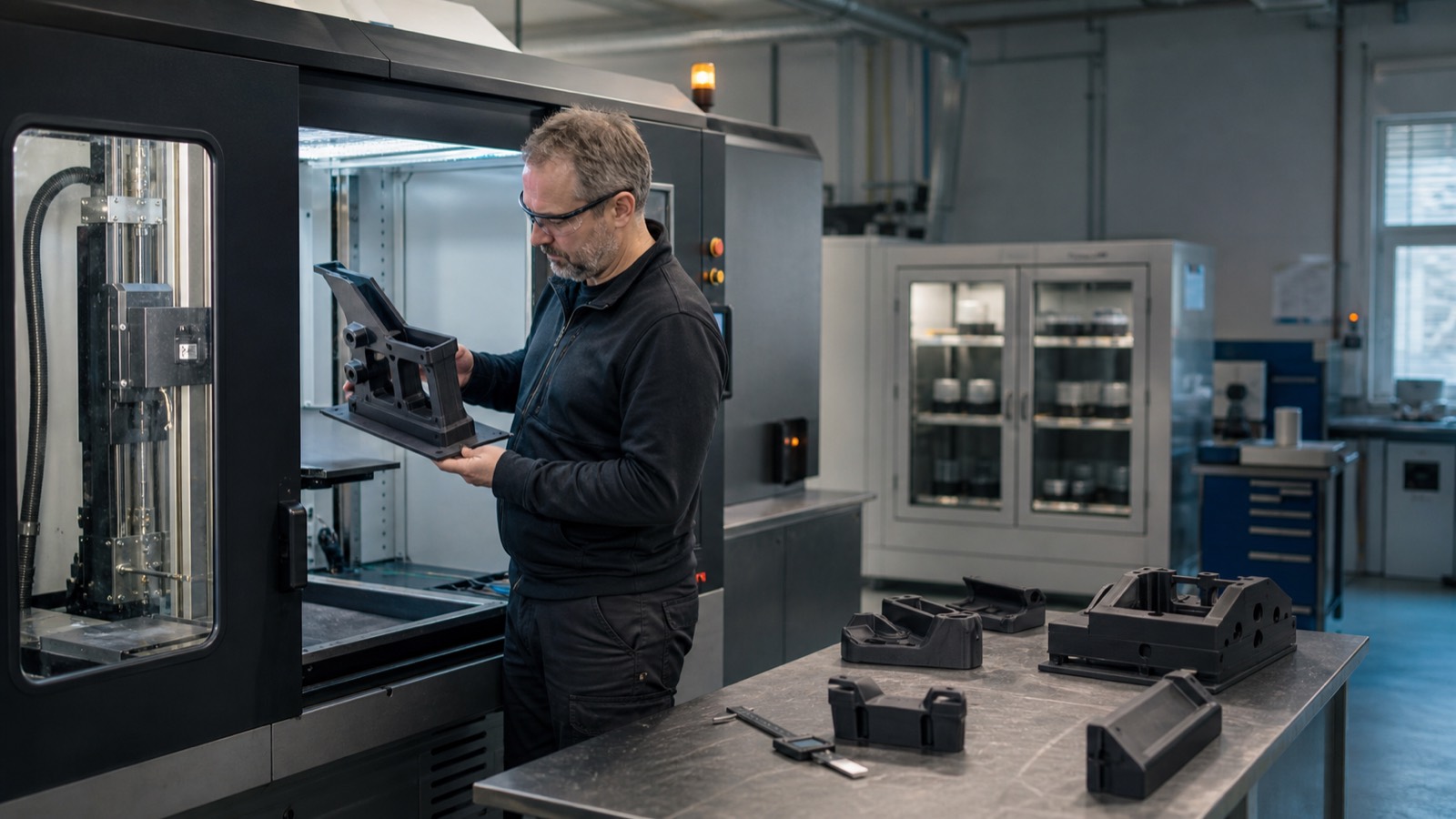
From functional prototypes and production tooling to low-volume parts, TS2 Space helps organisations evaluate industrial polymer printing as a complete, supportable manufacturing workflow.
BEYOND THE PRINTER
Repeatable parts require a controlled process
The correct platform depends on part geometry, mechanical performance, production volume, material traceability, finishing, operator skills and the economics of the complete print-to-part workflow.
Industrial FDM / FFF
Enclosed professional systems for functional prototypes, manufacturing aids, fixtures, replacement parts and engineering polymers.
Polymer SLS
Powder-bed production for complex geometry, nested batches and functional polymer components without conventional support structures.
Composite Printing
Engineering materials reinforced with chopped or continuous fibres for tooling, fixtures and lightweight structural applications.
Resin & DLP Systems
High-detail workflows for precision prototypes, casting patterns, mould applications and specialised professional production.
Software & Production Control
Build preparation, material profiles, job management, traceability, quality records and integration with the manufacturing environment.
Post-Processing & Safety
Material handling, extraction, depowdering, curing, finishing, inspection and facility requirements considered before installation.
APPLICATION-LED SELECTION
Start with the part and the production requirement
A higher-cost machine is not automatically the better manufacturing solution. We begin with the part family, required properties, quantity, lead time and verification method, then assess whether additive manufacturing is commercially and technically justified.
- Jigs, fixtures, gauges and assembly aids
- Functional prototypes and engineering validation
- Low-volume end-use polymer components
- Obsolescence management and selected replacement parts
- Patterns, moulds and production-process support
- Distributed manufacturing with controlled files and qualified processes
THE REAL COST PER PART
Evaluate the complete operating model
Machine price alone does not show whether a production case will succeed.
Material
Grade, reuse ratio, drying, storage, traceability, shelf life and validated process parameters.
Throughput
Build preparation, print time, cooling, unpacking, post-processing and realistic machine availability.
Quality
Dimensional checks, mechanical properties, repeatability, documentation and application qualification.
Lifecycle
Training, maintenance, software, consumables, service response and future platform support.
CURRENT PROFESSIONAL PLATFORMS
A multi-vendor view, subject to the authorised channel
Current professional polymer systems considered during market evaluation may include industrial Stratasys FDM platforms, EOS polymer SLS systems and UltiMaker Factor-series equipment. Other manufacturers may be a better fit depending on country, application and support requirements.
TS2 Space does not claim manufacturer authorisation or cross-border availability until the relevant supply and service route has been confirmed in writing.
- Destination and authorised reseller coverage
- Installation, warranty and local service capability
- Materials, software and consumables availability
- Operator, facility and safety requirements
- End-use and export review where applicable
METAL ADDITIVE MANUFACTURING
Handled as a separate, controlled qualification project
Metal additive systems can introduce materially different facility, powder-handling, process-safety, quality and export-control requirements. They are not treated as an automatic extension of the polymer portfolio.
Before proposing a metal system, the exact machine configuration, consolidation source, process atmosphere, monitoring capability, software, destination, end user and intended parts must be reviewed. Certain equipment may fall within EU dual-use entry 2B510 or other applicable controls.
No statement that a metal additive system is uncontrolled or licence-free will be made without documented product classification and transaction screening.
- Manufacturer classification and technical configuration
- Material and process qualification requirements
- Powder safety, extraction and facility readiness
- End-user, end-use, destination and sanctions screening
- Authorised sales, installation and service route
EVALUATE AN ADDITIVE-MANUFACTURING PROJECT
Tell us which parts or processes you want to improve
Share the destination country, material, part size, expected quantity, required properties, current manufacturing method and quality requirements. TS2 Space will review the business case and an appropriate authorised supply path.
Service availability, performance and permitted use depend on location, network capacity, local regulation, selected equipment and service plan. Specifications and commercial terms are confirmed individually.


